The Hamilton Electric 500
The battery-driven wristwatch Hamilton of Lancaster, Pennsylvania, put on sale in 1957: a balance wheel kept swinging by a coil and a button battery in place of a mainspring, which Hamilton’s own display calls the world’s first electric watch, and which the Science Museum in London and the Deutsches Uhrenmuseum keep.
Made 1957, By Hamilton Watch Company, Lancaster, Pennsylvania, Now at Science Museum, London (1958-248); Deutsches Uhrenmuseum, Furtwangen (watch 2005-097, movement 2004-002, display 2003-108)
Companies Hamilton
In the histories America industrializes the watch, The electric and quartz revolution
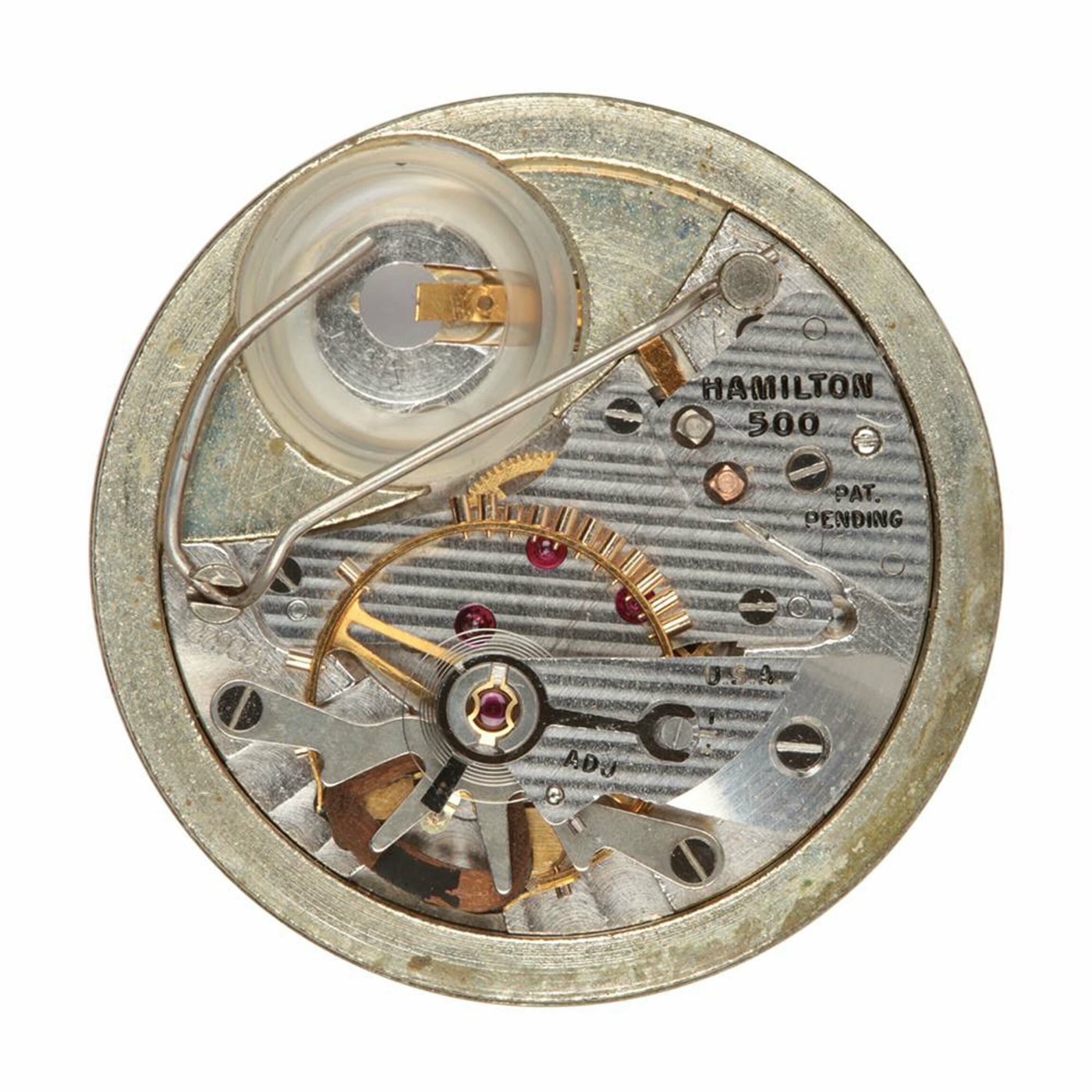
The watch
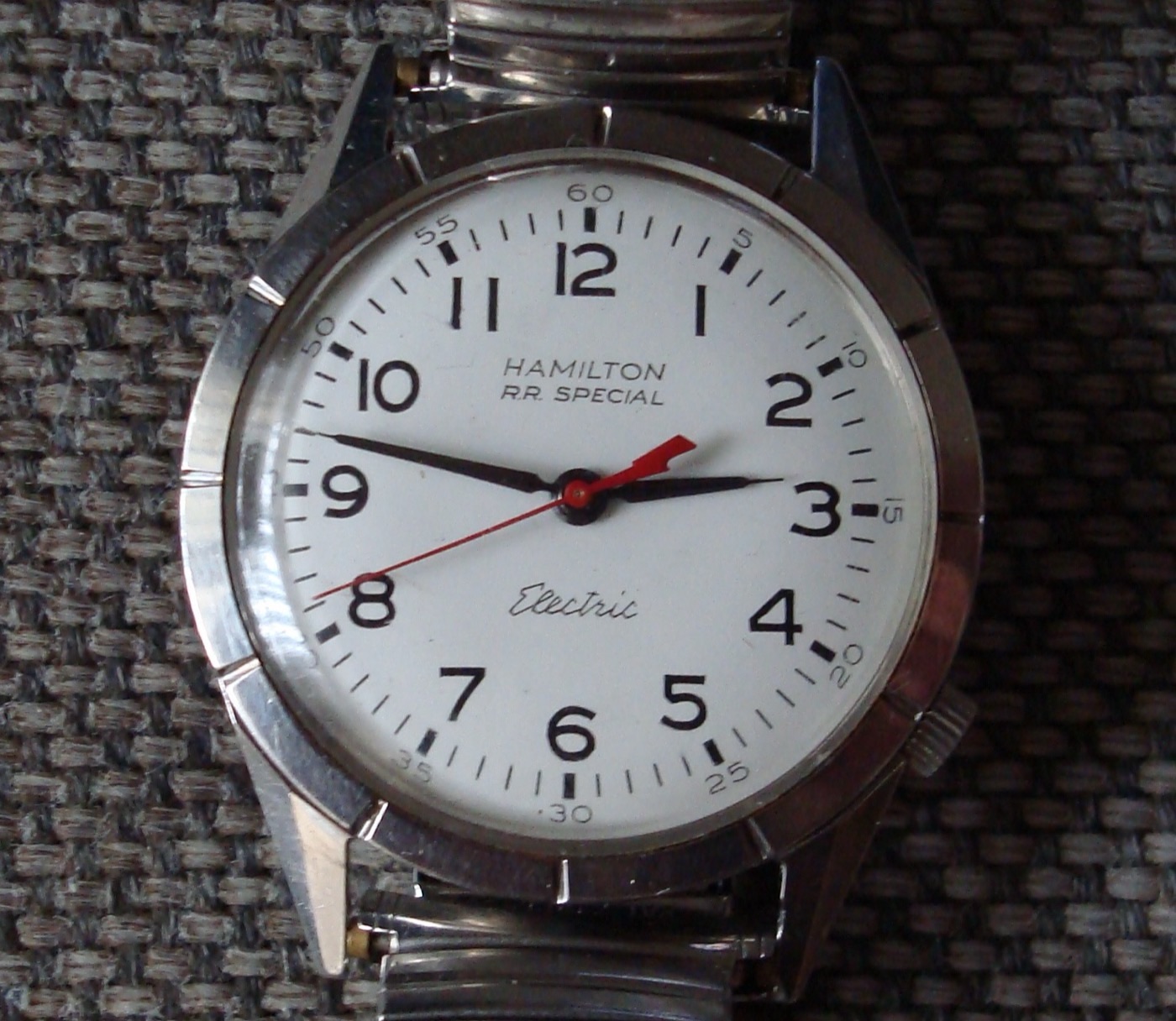
The Science Museum in London holds a complete Hamilton electric watch made in 1957 by the Hamilton Watch Company of Lancaster, Pennsylvania, with its strap and a spare battery. The record names Richard Arbib as its designer and the company itself as the giver.1, 7
Its movement, the calibre 500, keeps the balance wheel and hairspring of a mechanical watch but has no mainspring: a small coil on the balance swings past permanent magnets, and a contact sends a pulse of current from a button battery through the coil on each swing.2, 4, 8
Hamilton filed the patent on 12 February 1954 in the names of John A. Van Horn, Philip E. Biemiller and James H. Reese; it was granted on 2 June 1959 as US 2,888,797.2
René Rondeau, who wrote a book-length history of the watch, dates Hamilton’s research to 1946 and says it took more than ten years; Radio-Electronics reported in 1958 that the company had spent ten years on research and testing.4, 9
What changed
The battery took the place of the mainspring, so the watch never had to be wound. Radio-Electronics, in February 1958, describes the drive as a miniature reaction motor with the balance wheel as its rotor, and gives the battery a life of more than twelve months.4
Elgin and Lip had shown electric prototypes in 1952. The NAWCC Bulletin and Wikipedia say Hamilton’s was the first electric wristwatch to be produced and sold, and the shop display kept in Furtwangen calls it “The World’s First Electric Watch”.3, 5, 10
It still kept time mechanically: Seiko describes the Hamilton watch of 1957 as one in which the battery replaced the mainspring while the balance went on regulating. The next step removed the balance as well, in Bulova’s Accutron of 1960.10, 11, 12
Repair changed with it. Radio-Electronics told its readers that servicing the watch called for knowledge closer to a radio technician’s than a jeweller’s.4
Sold, revised and overtaken
Rondeau dates the press conference at which Hamilton announced the watch to 3 January 1957, and says it was an instant success.9
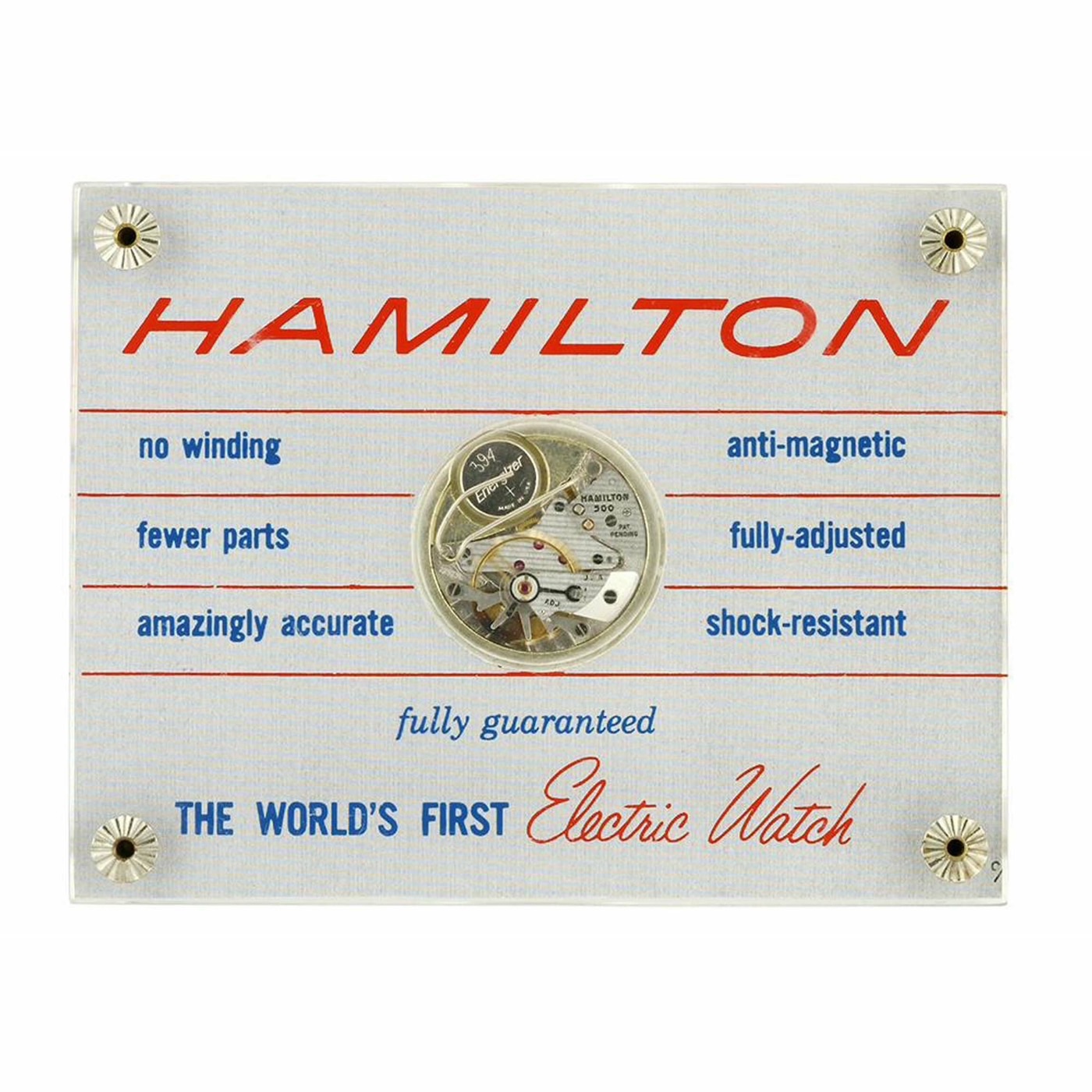
Hamilton put the movement in asymmetric cases designed by the industrial designer Richard Arbib (1917–1995), the triangular Ventura among them, and built clear plastic shop displays to let customers see the new movement; the Deutsches Uhrenmuseum holds a watch, a movement and a display.3, 8, 13, 14
The NAWCC Bulletin records a new Model 505 in 1961. Rondeau says production ended in 1969, when newer technology had made the watch obsolete; that year Hamilton closed its Lancaster works and moved its movement making to Switzerland.5, 9, 16, 17
Wikipedia’s account says Hamilton also made electric watches for Japan with Ricoh, in a joint venture of 1962 to 1965 that found little demand.19
Since
The Science Museum’s watch, object 1958-248, came from the Hamilton Watch Company itself, with its movement and a spare battery catalogued as a separate part.1, 7
The NAWCC Library and Research Center keeps Hamilton’s records, among them a series on electric watches from 1955 to 1978, mostly technical research and reports on movement design, contact alloys, cells and coils.20
Hamilton, now a brand of the Swatch Group, calls the Ventura its most iconic watch.14
Where the Hamilton Electric 500 leads
- Made by, CompanyHamilton
The Hamilton Watch Company made the electric watch in Lancaster, Pennsylvania, in 1957.1, 7
- Part of, HistoryAmerica industrializes the watch
The Lancaster factory’s electric watch of 1957, kept by the Science Museum, made twelve years before Hamilton moved its movement making to Switzerland.1, 16, 17
- Part of, HistoryThe electric and quartz revolution
Hamilton’s battery-driven watch of 1957, which the NAWCC Bulletin and Wikipedia say was the first electric wristwatch sold.1, 5, 10
- See also, TechnologyThe electric watch
The balance-wheel type of electric watch: a coil on the balance, impulsed from a battery, under Hamilton’s patent of 1954.1, 2
- See also, ObjectThe Bulova Accutron
Three years after Hamilton’s battery watch, the Accutron removed the balance wheel as well.1, 10, 12
Facts and sources
- Made
- 19571, 9
- Held by
- Science Museum, London (1958-248); Deutsches Uhrenmuseum, Furtwangen (watch 2005-097, movement 2004-002, display 2003-108)1, 3, 8, 13
Sources
- 1
Hamilton Electric Wrist-Watch, 1957 (object 1958-248) (opens in a new tab)
- 2
- 3
Werbedisplay, Hamilton, Lancaster (USA), um 1957 (Inv. 2003-108) (opens in a new tab)
- 4
Electric Wristwatch, Radio-Electronics, February 1958 (reproduced by RF Cafe) (opens in a new tab)
- 5
- 6
- 7
Hamilton Electric Wrist-Watch, 1957 (object 1958-248) (opens in a new tab)
- 8
Armbanduhrwerk, Hamilton, Lancaster (USA), um 1957 (Inv. 2004-002) (opens in a new tab)
- 9
- 10
- 11
History of Seiko and its products, stage 3 (1960s to 1980s) (opens in a new tab)
- 12
Bulova 'Accutron' electronic wristwatch, c. 1963 (object 1963-306) (opens in a new tab)
- 13
Armbanduhr, Hamilton, Lancaster (USA), um 1957 (Inv. 2005-097) (opens in a new tab)
- 14
- 15
- 16
- 17
- 18
- 19
- 20
Sources read November 12, 2026.