The Bulova Accutron
Bulova’s Accutron, on sale from 1960: a wristwatch kept in time by a tuning fork vibrating 360 times a second and driven by a transistor, designed by the Swiss engineer Max Hetzel in Biel. It took the balance wheel out of the watch a decade before quartz, and its movement later timed work on Skylab.
Made 1960, By Bulova Watch Company, New York; designed by Max Hetzel, Now at Science Museum, London (1963-306); National Maritime Museum, Greenwich (ZBA4265); Deutsches Uhrenmuseum, Furtwangen (47-3408)
Companies Citizen
In the history The electric and quartz revolution
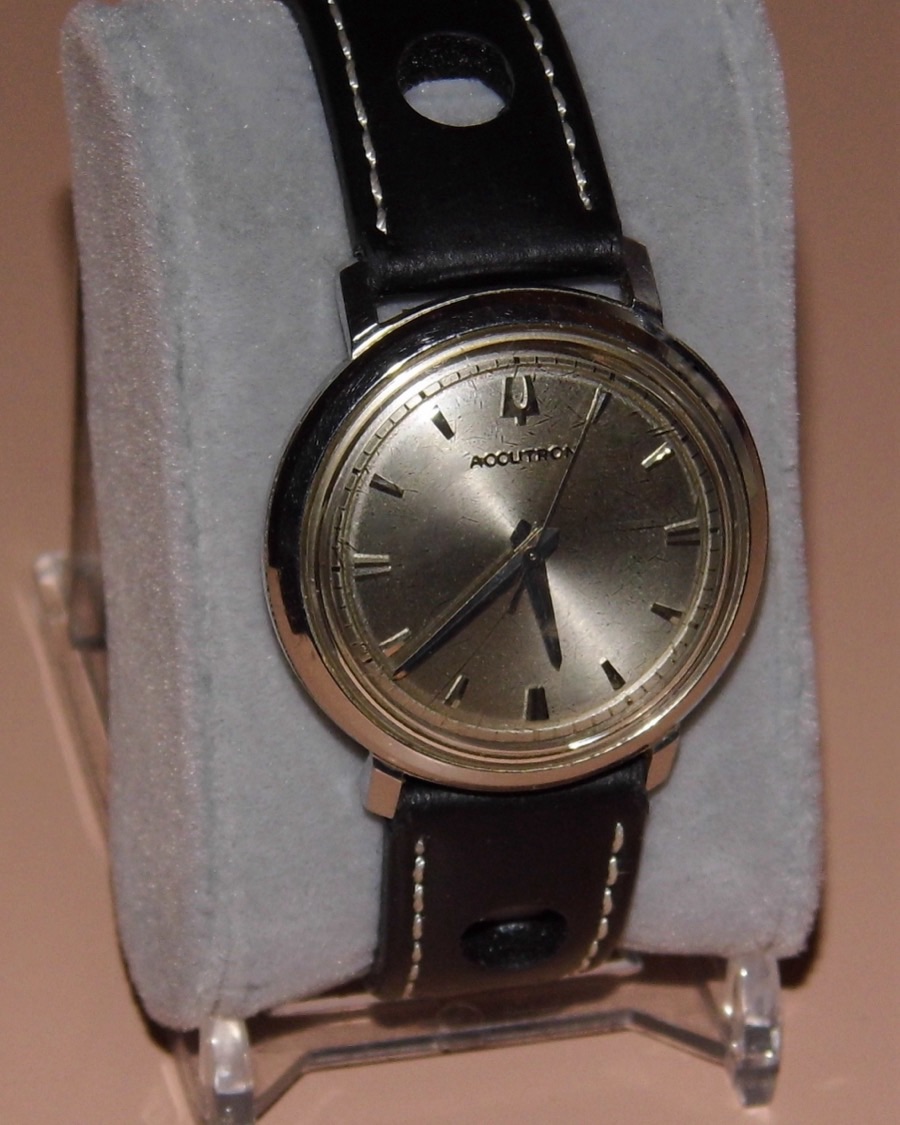
The watch
The Accutron has no balance wheel and no mainspring. A small tuning fork vibrating 360 times a second is kept going by a transistor circuit and a battery that lasts about a year, and a mechanism on the fork turns its vibration into the rotation that drives the hands.2, 3, 5
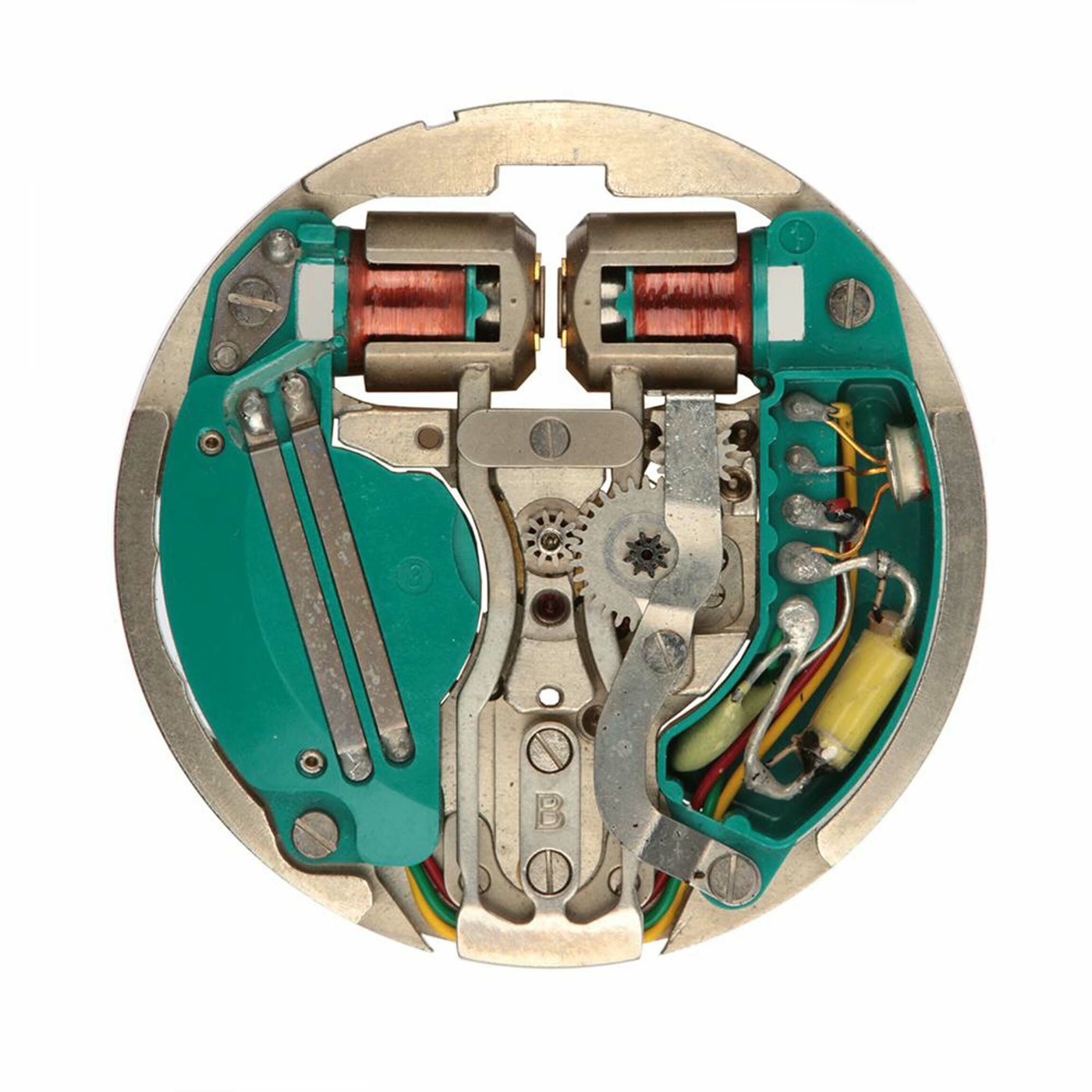
Its designer was Max Hetzel (1921–2004), an electrical engineer from Basel who joined Bulova’s works in Biel in 1950. By the German Wikipedia’s account, Bulova’s American head asked him in 1953 to study electromechanical watches, and he proposed a transistor-driven tuning fork instead.1, 5, 8
Bulova filed a Swiss patent on 19 June 1953, published in 1955 as CH 312290. The American patent for an electronically controlled timepiece, US 2,971,323, names Hetzel of Biel as inventor and was granted on 14 February 1961.2, 9
Wikipedia records that Hetzel moved to Bulova in New York in 1959 and that series production began in 1960; the NAWCC Bulletin dates the watch’s introduction to October and its sale to November of that year.8, 10
The Science Museum’s example of 1960 to 1963, made in New York, came mounted on a sloping wooden stand with an animated diagram of how it works. The Deutsches Uhrenmuseum’s calibre 214 H movement of 1964 was made in Switzerland.1, 11
What changed
The tuning fork took the place of the balance as the part that keeps time. The Royal Museums Greenwich record calls the Accutron the first electronic watch and the first not to use a balance as its timing element.3
Bulova gives its accuracy as within a minute a month; Wikipedia’s biography of Hetzel gives two seconds a day at most.5, 8, 12
Seiko says the Accutron shocked the watch industry and set off a race for electronic accuracy, and a researcher at Neuchâtel’s Centre Electronique Horloger counts it among the threats behind that laboratory’s founding in 1962.13, 14
Shown, buried and flown
The Spaceview, with a clear dial over the movement, began as a way of showing the tuning fork to customers, the Greenwich record says, and became popular enough for Bulova to make it for sale.3
In 1964 an Accutron was chosen for the 5,000-year time capsule buried at the New York World’s Fair, as an example of the most innovative objects of the previous 25 years, by the same record’s account.3
Its movement also timed work in space. The National Air and Space Museum holds a Bulova timer with an Accutron movement, a flight-qualified backup of the timers astronauts used on the Skylab missions of 1973 and 1974, installed in the Skylab orbital workshop on show in the museum.4, 15
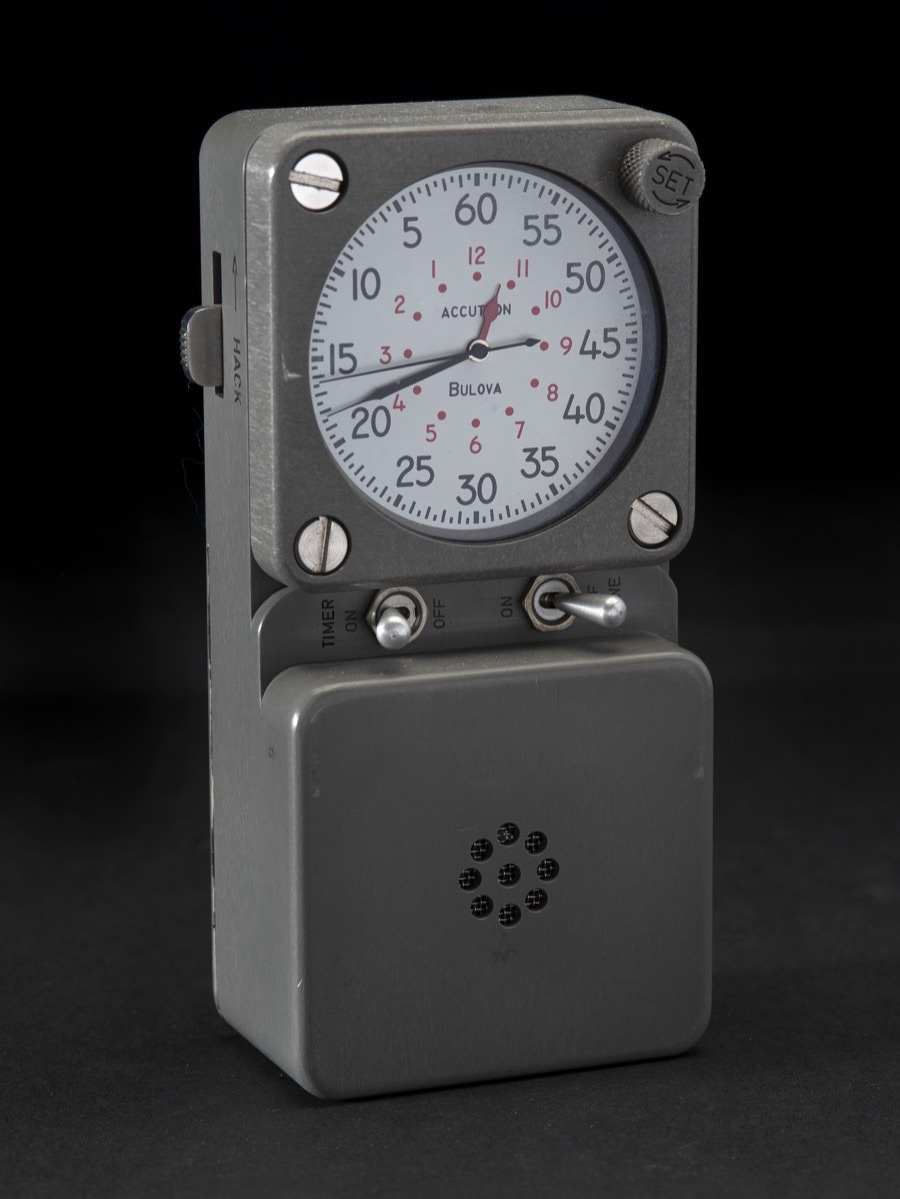
More than four million Accutrons had been sold by 1973, and the NAWCC Bulletin puts the total above five million when production ended in 1977.5, 10
Hetzel returned to Switzerland, Wikipedia records, to work for the Centre Electronique Horloger in Neuchâtel and then for Omega until 1973.8
Since
Accutrons are held by the Science Museum in London, the National Maritime Museum at Greenwich and the Deutsches Uhrenmuseum in Furtwangen, which keeps watches and movements from 1964 into the 1970s.1, 3, 11, 17
Citizen bought Bulova in 2008, JCK reports, and Bulova says it launched a new Accutron in 2020, driven by electrostatic induction.12, 18
Key dates
- 1950
Max Hetzel joins Bulova in Biel.5, 8
- 1953
Bulova files the Swiss patent for a tuning-fork timepiece, 19 June.2, 9
- 1960
The Accutron goes on sale.1, 5, 10
- 1961
US patent 2,971,323 is granted to Hetzel’s design.2
- 1964
An Accutron goes into the time capsule of the New York World’s Fair.3
- 1973
Bulova timers with Accutron movements on the Skylab missions.4
- 1977
The NAWCC Bulletin dates the end of production, after more than five million.10
Where the Bulova Accutron leads
- Part of, HistoryThe electric and quartz revolution
Bulova’s tuning-fork watch of 1960, designed by Max Hetzel, which replaced the balance wheel with a transistor-driven fork.1, 2
- See also, CompanyCitizen
Bulova, which made the Accutron, has been a Citizen subsidiary since January 2008.18, 19
- See also, TechnologyThe electric watch
The tuning-fork type of electric watch, patented for Bulova from 1953.1, 2, 9
- See also, TechnologyThe quartz watch
Seiko says the Accutron set off a race for electronic accuracy that ended in its quartz watch.13
- See also, ObjectThe Hamilton Electric 500
Three years after Hamilton’s battery watch, the Accutron removed the balance wheel as well.1, 20, 21
Facts and sources
- Made
- 19601, 5, 10
- Maker
- Bulova Watch Company, New York; designed by Max Hetzel1, 2
- Held by
- Science Museum, London (1963-306); National Maritime Museum, Greenwich (ZBA4265); Deutsches Uhrenmuseum, Furtwangen (47-3408)1, 3, 17
Sources
- 1
Bulova 'Accutron' electronic wristwatch, c. 1963 (object 1963-306) (opens in a new tab)
- 2
US 2,971,323: Electronically-controlled timepiece (opens in a new tab)
- 3
Bulova ‘Accutron’ tuning-fork wristwatch (ZBA4265) (opens in a new tab)
- 4
- 5
- 6
A Bulova Accutron, model 214, with the date code M3 for 1963, by its record. (opens in a new tab)
- 7
- 8
- 9
- 10
- 11
Armbanduhrwerk, Bulova, Schweiz, 1964 (Inv. 48-2853-E17) (opens in a new tab)
- 12
- 13
History of Seiko and its products, stage 3 (1960s to 1980s) (opens in a new tab)
- 14
First-Hand: The First Quartz Wrist Watch (opens in a new tab)
- 15
Timer, Skylab (National Air and Space Museum, via DPLA) (opens in a new tab)
- 16
- 17
Armbanduhr, Bulova, USA, 1964 (Inv. 47-3408) (opens in a new tab)
- 18
Citizen completes acquisition of Bulova (11 January 2008) (opens in a new tab)
- 19
- 20
- 21
Hamilton Electric Wrist-Watch, 1957 (object 1958-248) (opens in a new tab)
Sources read November 12, 2026.