Casio
A Tokyo electronics company that came to watches from calculators. It entered the trade in 1974 with a digital quartz watch built on its calculator chips, and in 1983 launched the shock-resistant G-Shock.
Founded 1946, as Kashio Seisakujo, Mitaka, Tokyo, Japan
In the histories Japan builds a watch industry, The electric and quartz revolution
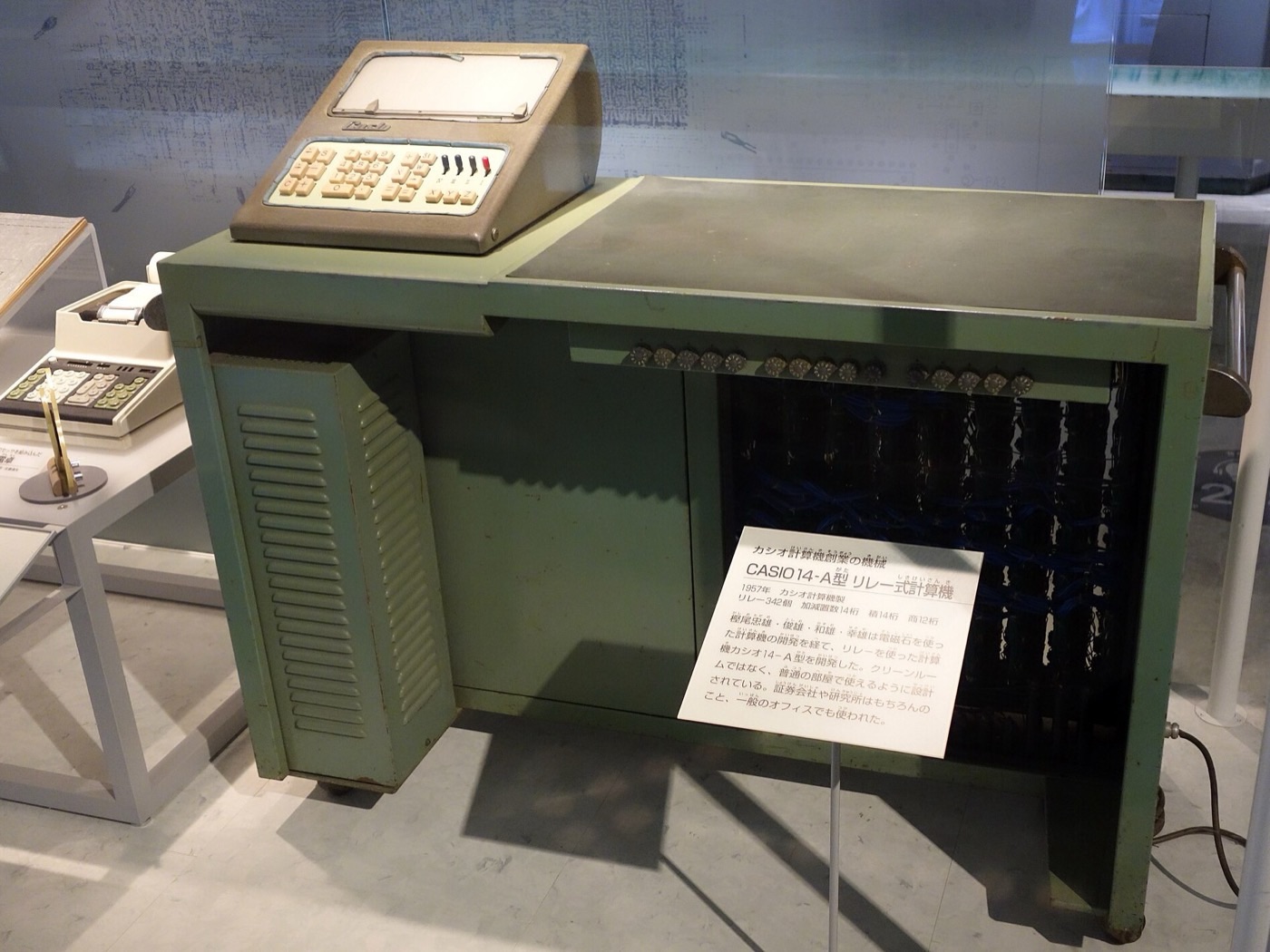
Calculators first
Kashio Seisakujo was a small subcontractor making parts such as microscope components and gears. Tadao’s brother Toshio left his job to join it, and Kazuo and Yukio followed: the company became the work of four brothers.1
A finger-ring cigarette holder Toshio designed sold well enough to pay for work on calculators. In June 1957 the brothers put the 14-A relay calculator on sale and formed Casio Computer Co., Ltd., with their father, Shigeru Kashio, as president.1

Digital watches and the G-Shock
Casio came to watches in November 1974 with the Casiotron, choosing digital quartz because the integrated circuits it had built for calculators would carry over. Its calendar adjusted itself to the length of each month. The X-1 of 1976 added a stopwatch and world time, the start of a long line of multi-function digital watches.2
The G-Shock DW-5000C went on sale in April 1983, its case reinforced with a urethane bezel and its module suspended inside so that a knock would not reach it. Nippon.com describes how it began with an engineer’s 1981 proposal for a watch that would survive a fall, and took more than 200 prototypes; its design belongs to the story of Tool-watch engineering.3, 6
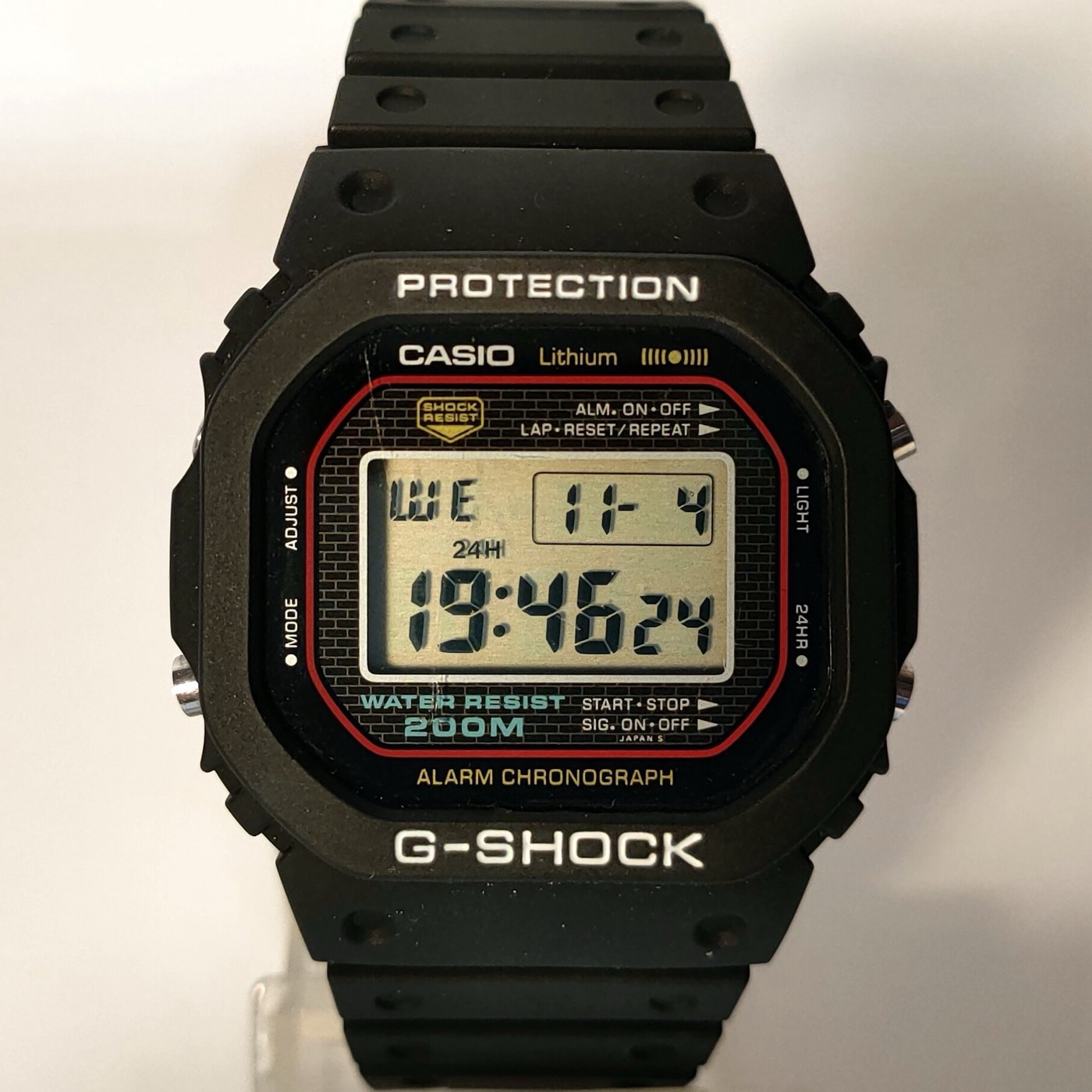
G-Shock caught on abroad before it did at home, and by the mid-1990s had become a fashion piece for the young; Baby-G, a version for women, followed in December 1994. By August 2017 Casio had shipped 100 million G-Shocks, and in 2023 the shape of the original was registered as a three-dimensional trademark.3, 8, 9, 10
Later watches carried the electronics further: a solar-powered radio-controlled watch in 2001, a G-Shock linked to a smartphone by Bluetooth in 2012, and in 2014 one that takes the time from GPS satellites as well as radio signals. In July 2025 Casio released the EDIFICE EFK-100, which it calls its first mechanical watch.9, 10, 11
Key dates
- 1946
Tadao Kashio sets up Kashio Seisakujo in Mitaka, Tokyo.1
- 1957
Casio Computer Co., Ltd. is formed; the 14-A relay calculator goes on sale.1, 5
- 1974
The Casiotron, a digital quartz watch with an automatic calendar.2
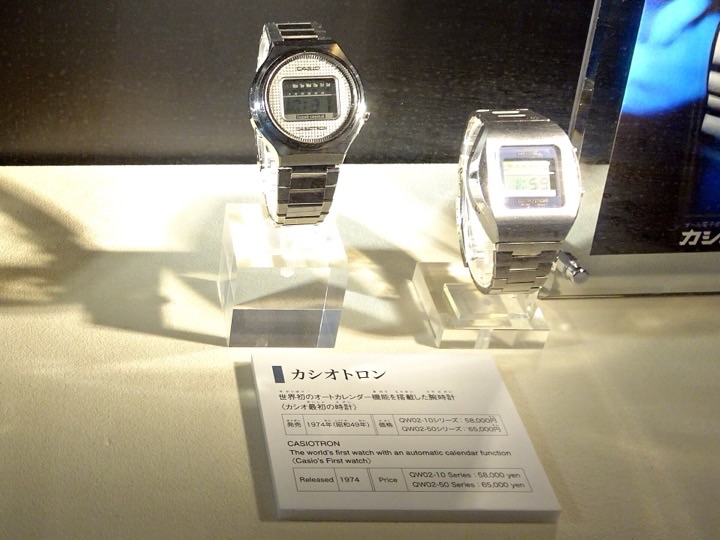
A Casiotron of 1974, on display.12 Photograph: ブルーノ・プラス. View full original at Wikimedia Commons (opens in a new tab) · 2,457 × 1,843 px; CC BY 4.0 (opens in a new tab). - 1976
The X-1, with stopwatch and world time.2
- 1994
Baby-G, a shock-resistant watch for women.8
- 2001
The WVA-300, a solar-powered radio-controlled watch.11
- 2017
100 million G-Shock watches shipped.9
- 2023
The original G-Shock’s shape is registered as a three-dimensional trademark.10
- 2025
The EDIFICE EFK-100, a mechanical watch.10
Where Casio leads
- Developed, TechnologyThe quartz watch
Casio’s Casiotron of 1974 was a digital quartz watch built on its calculator chips.2, 13
- Based in, PlaceTokyo
Casio began in Mitaka, Tokyo, in 1946.1
- Part of, HistoryJapan builds a watch industry
The calculator maker that came to watches in 1974.2, 14
- Part of, HistoryThe electric and quartz revolution
Casio entered watches in 1974 with the digital quartz Casiotron.2, 13
- Part of, TraditionJapanese watchmaking
A calculator maker’s route into Japan’s watch industry, from 1974.1, 2
- Part of, TraditionTool-watch engineering
Nippon.com describes the G-Shock, on sale from 1983, as designed from the start to survive being dropped.6
- Part of, EventThe quartz crisis
The switch to quartz that gave a calculator maker its way into watches.2
Elsewhere in Watch Vault
- Current coverage
Stories that name Casio, newest first (opens in a new tab), in Watch Vault Media.
Facts and sources
- Founded
- 1946, as Kashio Seisakujo1
- Founder
- Tadao Kashio, joined by his brothers1
- Founded in
- Mitaka, Tokyo, Japan1
- Company formed
- 1957, as Casio Computer Co., Ltd.1, 5
- Watches since
- 19742
- Based in
- Shibuya, Tokyo5
- Official site
- world.casio.com (opens in a new tab)1, 5
Sources
- 1
- 2
- 3
- 4
- 5
- 6
Tough and timeless: the development of the G-Shock (opens in a new tab)
- 7
The first Casio G-Shock, DW-5000C with module 240, of 1983. (opens in a new tab)
- 8
- 9
- 10
- 11
- 12
The first Casiotron, Casio's first wristwatch, on display. (opens in a new tab)
- 13
- 14
Sources read November 11, 2026.