ASUAG
The holding company set up in 1931 with federal money to control the makers of ébauches, balances, hairsprings and escapement parts and so stop the export of watch parts; it later bought finished-watch brands, and in 1983 it was rescued by the banks and merged with SSIH into the company that became the Swatch Group.
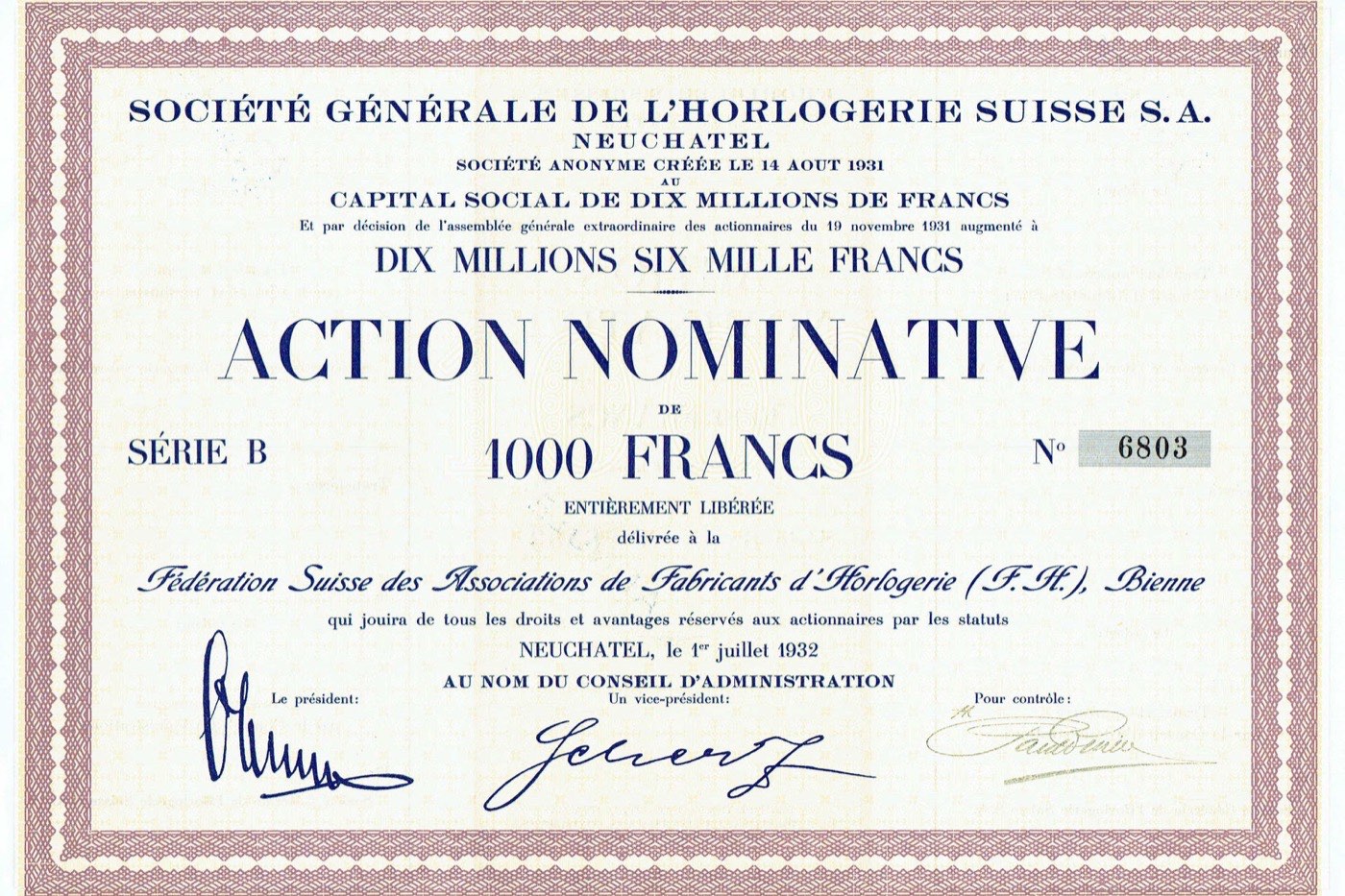
Founded 14 August 1931, Owned by Banks (series A shares), the watch industry (series B) and the Confederation (series C)
In the histories Switzerland’s network of specialists, Crisis, consolidation and the groups

The brands
| Brand | Since | How it came |
|---|---|---|
| ETA | Formerly | Donzé writes that ETA belonged to ASUAG until the merger of 1983.4 |
| Longines | Formerly | ASUAG bought Longines in 1972, by the Historical Dictionary’s date, and held it in General Watch Co. until the merger of 1983.3, 4 |
A superholding against chablonnage
The parts makers’ own agreements of 1928 had not stopped chablonnage, the export of ébauches and parts to be assembled abroad. The Federal Council records that in July 1931 a petition with 56,000 signatures asked it to intervene at once.1, 2
ASUAG, the Société générale de l’horlogerie suisse SA, was founded on 14 August 1931 and asked the federal authorities for money a week later. The Federal Council’s message of 1983 calls it a “superholding” meant to control the making of ébauches and of the regulating parts, a task it says was beyond the industry’s own strength.1
Under the federal decree of 26 September 1931 the Confederation put 6 million francs into its capital, lent it 7.5 million francs free of interest and could name up to five of its directors. Its shares could not be sold.1, 2
The capital of 10,006,000 francs was held in three series: 5,000 shares of 1,000 francs taken by the participating banks, 5,000 taken by the watch industry, and 6,000 shares of one franc each paid for by the Confederation at 1,000 francs apiece. The Federal Council called the difference a subsidy, used to write down shares that paid no dividend.1
The Federal Council quotes the aim set in its statutes: to promote the regrouping of watch manufacturing in Switzerland in the interest of reorganising the whole industry, a purpose it says stood apart from that of a company run for profit.1
The four trusts
From the start ASUAG controlled four groups: Ebauches SA for ébauches, the Fabriques d’Assortiments Réunies for escapement parts, the Fabriques de Balanciers Réunies for balances and the Société des Fabriques de Spiraux Réunies for hairsprings.1, 3
It took a majority of Ebauches SA in 1931 because outside makers kept exporting, and it did not complete its control of all the ébauche and regulating-part makers until the winter of 1940-41.2, 6
The Grail Watch reference wiki gives the dates on which the parts trusts were registered: the assortment makers at Le Locle on 9 September 1932 and the balance makers at Les Ponts-de-Martel on 24 October 1932. It adds that the hairspring trust took the name Nivarox in 1977 and merged with the assortment makers as Nivarox-FAR in 1984.7
The trusts worked inside the watch statute. Opening, enlarging or taking over a watch firm needed a federal permit until the end of 1965, the export of parts and machines was controlled, and the finished-watch firms bound themselves to buy their ébauches and parts in Switzerland.1, 2
From trust to watch group
As the cartel was loosened from 1962, ASUAG moved into finished watches. The Historical Dictionary of Switzerland lists Rado in 1968, Mido in 1971, and Certina and Longines in 1972.3, 8
Donzé writes that in 1971 it set up General Watch Co. to hold its finished-watch companies, Longines and Rado among them. The Grail Watch wiki dates the holding to 18 February 1971 and says Longines joined it later that year, a year earlier than the Historical Dictionary gives.3, 4, 7
Donzé counts the cost of that growth. ASUAG’s assets rose from 54.5 million francs in 1970 to 234.1 million in 1974 and gross sales from 760 million to a peak of 1.4 billion, while borrowed capital grew from 23.7 to 28.3 per cent of assets. From 1975 to 1978 sales fell below 1.2 billion a year and the company leaned more on the banks.4
The public part shrank. The Confederation took no part in later increases of capital, so its share fell from 30 per cent to 8; its loan was repaid, and from 1980 it named two directors instead of five. By 1983 the Federal Council described ASUAG as a financial holding run purely on private lines and more and more a competitor of the Swiss watch firms.1
The rescue of 1983
Early in 1982 the banks granted ASUAG a moratorium until 30 June 1983, a special management committee was set up and Hayek Engineering of Zurich was asked to analyse the group. At the end of 1982 the holding had lost 156.5 million francs, more than its own funds of 134 million.1, 4
On 29 June 1983 the shareholders cut the old capital of 75 million francs by 90 per cent. The creditor banks gave up 30 million francs of claims and turned 392.5 million more into capital, and the rescue was tied to a merger with SSIH: of the merged group’s 300 million francs of share capital, ASUAG would hold 200 million and SSIH 100 million.1
The Confederation’s 6 million francs became 600,000, 0.2 per cent of the merged capital. On 14 September 1983 the Federal Council asked parliament to let it sell the stake and to repeal the decree of 1931, judging that a public role in ordering the industry no longer fitted a group run on private lines.1
The merged ASUAG-SSIH was split into three sub-groups, for finished watches, for ébauches and components and for industrial products, under a financial holding. It took the name SMH in 1985, as the Swatch Group and the Historical Dictionary date it, and became the Swatch Group in 1998.1, 3, 4, 9
Donzé writes that ETA, an ASUAG company until 1983, became the place where the merged group concentrated the making of movements and parts, continuing the mergers Ernst Thomke had led at ETA since 1978. That story is told under ETA.4
Key dates
- 1931
ASUAG is founded on 14 August; the federal decree of 26 September gives it 6 million francs of capital and an interest-free loan.1
- 1962
The loosening of the cartel begins; ASUAG starts to buy finished-watch brands.1, 3
- 1971
General Watch Co. is set up for ASUAG’s finished-watch companies.4, 7
- 1983
Shareholders approve the rescue and the merger with SSIH on 29 June; the federal stake falls to 600,000 francs.1
- 1985
ASUAG-SSIH is renamed SMH.3, 9
Where ASUAG leads
- Led to, GroupThe Swatch Group
ASUAG merged with SSIH in 1983 into the company renamed SMH in 1985 and the Swatch Group in 1998.1, 3, 9
- Formerly owned, GroupEbauches SA
ASUAG took a majority of Ebauches SA in 1931 and held it until the merger of 1983.1, 2, 6
- Part of, HistoryCrisis, consolidation and the groups
The parts trust of 1931, rescued by the banks and merged with SSIH in 1983.1, 3
- Part of, HistorySwitzerland’s network of specialists
ASUAG, founded in 1931 with federal money, bought control of the makers of ébauches and regulating parts that the network depended on.1, 2
- See also, PersonNicolas G. Hayek
Hayek Engineering of Zurich was asked in 1982 to analyse ASUAG, the study that led to the merger.1, 4
- See also, EventThe quartz crisis
ASUAG, the cartel-era holding of the parts makers, was the other group the crisis brought near insolvency.3, 9
- See also, EventThe Swiss watch cartel and statute
ASUAG was set up under the federal decree of 26 September 1931, among the measures that grew into the watch statute.1, 2
Facts and sources
- Founded
- 14 August 19311
- Full name
- Société générale de l'horlogerie suisse SA (in German, Allgemeine Schweizerische Uhrenindustrie AG)1, 3
- Owners in 1931
- Banks (series A shares), the watch industry (series B) and the Confederation (series C)1
- Ended
- 1983, merged with SSIH1, 3
Sources
- 1
- 2
- 3
- 4
- 5
- 6
- 7
- 8
- 9
Sources read November 12, 2026.