The Swiss watch cartel and statute
The private cartel of the Swiss watch industry and the federal rules that enforced it, from the conventions of 1 December 1928 to the end of the watch statute on 31 December 1971: permits to export parts and to open or change a watch firm from 1934, minimum prices binding on every firm from 1936 to 1951, then a staged opening from 1962.
1 December 1928 (the industry conventions) to 31 December 1971 (the end of the federal statute)
Companies Longines
In the histories Switzerland’s network of specialists, Crisis, consolidation and the groups
Before: a crisis and private agreements
After the crisis of the early 1920s, and as other countries raised duties on finished watches, foreign buyers imported Swiss movements in loose parts and assembled them abroad. This chablonnage, which the Federal Council defined as the export of ébauches and movement parts, fed foreign makers and pushed prices down.1, 3, 5
The makers organised by level of production: the watch manufacturers in the FH in 1924, the ébauche makers in Ebauches SA in 1926, and the parts makers in the UBAH in 1927.1, 6
On 1 December 1928 the three bodies signed conventions to hold minimum prices and stop the export of ébauches and loose movements. The FH says parts could still go to France, Germany, Poland and Japan.1, 6
Ébauche makers outside the conventions kept exporting. In 1931 the industry formed ASUAG to buy control of the makers of ébauches, balances, hairsprings and escapement parts; under a federal decree of 26 September 1931 the Confederation took 6 million francs of its capital, named five of thirty directors and lent 7.5 million francs free of interest.1, 7
What happened: the state enforces the cartel
Because ASUAG alone could not stop the outsiders, a Federal Council decree of 12 March 1934 made permits necessary to export chablons, ébauches and parts, and to open, enlarge or transform any watch firm.1, 3, 6
A decree of 13 March 1936 let the economics department make the industry’s minimum prices binding on every watch firm and required permits to export watches and movements. On 1 April 1936 the private agreements were merged into one “Convention collective de l’industrie horlogère”.1, 3
The measures were gathered in a decree of 29 December 1937 and renewed through the Second World War, the last time for three years on 23 December 1948; they rested on the emergency powers for economic defence of 1933. With exports and prices now controlled by law, ASUAG was able to buy the last independent makers of ébauches and regulating parts in the winter of 1940–41, the Confederation paying 900,000 of the 3.3 million francs.1
The collective convention rested on what the Federal Council called syndical reciprocity: FH members bought their ébauches and parts from Ebauches SA and UBAH members, who sold to them alone; FH members made no ébauches for sale and Ebauches SA made no watches. The cheaper Roskopf, or pin-lever, watch stayed outside the convention.1
The new economic articles of the constitution required a federal decree open to referendum. The decree of 22 June 1951, the “statut légal de l’horlogerie”, kept export and manufacturing permits from 1952 but gave up price-fixing by the state.1, 3
What changed
Every new watch firm needed a permit. Boillat and Garufo write that the consultative commission that advised on permits from 1946 was most restrictive on new firms, to limit competition, and on changes of branch, to keep the industry divided into specialised firms.8
In 1960 the Federal Council wrote that the cartel and the federal measures had helped the industry out of the crisis of the 1930s but were not the main cause of its postwar growth, and that the rules still bore the mark of the crisis years and held back competition and initiative.1
The controls reached machines. Donzé writes that the cartel had controlled the export of watchmaking machines since 1934 and that its agency Machor refused machines ordered by Hattori and Citizen in the early 1950s, keeping the ban until 1965; the Japan Clock & Watch Association says Japan replaced its worn machinery around 1950 with precise machines from Switzerland. The dispute is set out under Japan builds a watch industry.9, 10
The Federal Council chose to open up even the ébauche and regulating-parts trades, against the FH’s wish to keep manufacturing permits there; it called the privileged position of ASUAG the central question of the reform.1
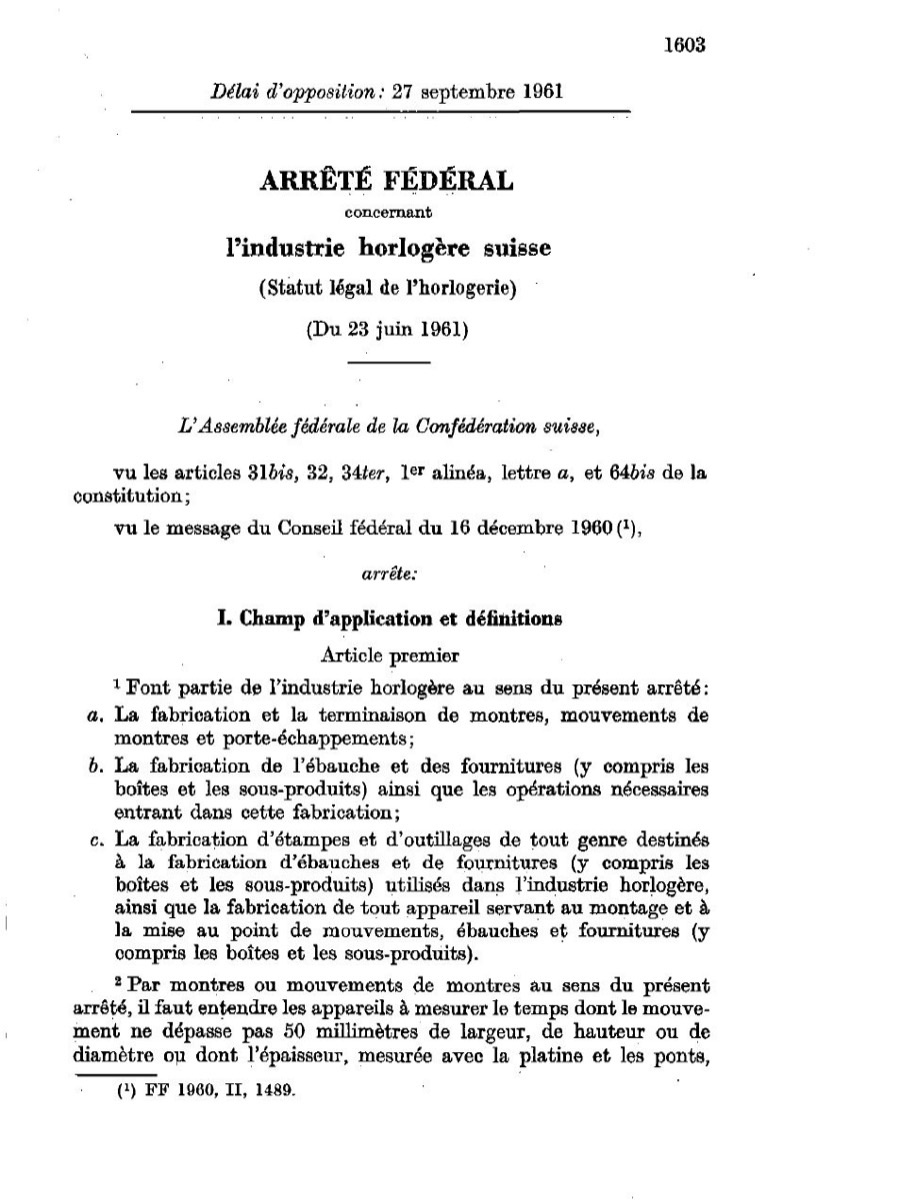
The revised statute of 23 June 1961 was approved by 66.7 per cent of voters on 3 December 1961. From 1 January 1962 it set a technical control of exported watches by sampling, let the Federal Council require export permits for movements, ébauches, parts, tools, plans and watch machines, and kept manufacturing permits until 31 December 1965.2, 3, 11
What came next
The 1961 statute ran until 31 December 1971, apart from its transitional articles. The FH says the regime was abandoned completely in the early 1970s, and the Historical Dictionary of Switzerland says the technical control became a quality control under the “Swiss made” rules from 1972.2, 3, 6
On 23 December 1971 the Federal Council issued the ordinance on the use of the name “Swiss” for watches, in force from 1 January 1972. It defined a Swiss movement by where it was assembled and inspected and by the Swiss share, at least half, of the value of its parts; the rule that a Swiss watch must also be cased in Switzerland was added in 1992. Its later history is told under Origin labels.12, 13
Trade policy took over from the permits. A supplementary watch agreement with the European Economic Community, signed on 20 July 1972 and in force from 1 January 1973, cites the 1971 ordinance, lets ébauches made in the Community count toward the Swiss share under certification, and records the end of the rationalisation premiums paid by Ebauches SA and ASUAG.14
The Historical Dictionary of Switzerland says ASUAG moved into finished watches as the rules loosened, buying Rado (1968), Mido (1971), Certina (1972) and Longines (1972), and that the cartel had neglected electronic watches. The statute expired as the quartz crisis began; that story continues in Crisis, consolidation and the groups.15, 16
Key dates
- 1928
The FH, Ebauches SA and the UBAH sign conventions on minimum prices and against chablonnage (1 December).1, 6
- 1931
ASUAG is formed; a federal decree of 26 September commits 6 million francs of capital.1, 7
- 1934
Federal Council decree of 12 March: permits to export parts and to open or enlarge watch firms.1, 3
- 1936
Minimum prices made binding (13 March); the Convention collective joins the private agreements (1 April).1, 3
- 1951
Federal decree of 22 June: the “statut légal de l’horlogerie”, without state price-fixing.1, 3
- 1961
Voters approve the revised statute with 66.7 per cent (3 December).2, 11
- 1962
Technical control of exported watches begins (1 January).2, 3
- 1965
Manufacturing permits end (31 December).2
- 1971
The Swiss made ordinance is issued (23 December); the statute expires (31 December).2, 12
Where the Swiss watch cartel and statute lead
- Part of, HistoryCrisis, consolidation and the groups
The cartel rules that built ASUAG and ended in 1971.3, 15
- Part of, HistorySwitzerland’s network of specialists
The federal rules that held the industry in place from 1934 to 1971.1, 2
- See also, HistoryJapan builds a watch industry
Donzé says the Swiss cartel refused watchmaking machines to Japanese makers until 1965.9
- See also, CompanyLongines
The Historical Dictionary of Switzerland says ASUAG bought Longines in 1972, as the end of the statute let it move into finished watches.15
- See also, PlaceBiel/Bienne
ASUAG, formed in 1931 with the Confederation's help, was the cartel's holding for the makers of ébauches and parts.6, 15
- See also, PlaceHong Kong
Donzé says the ordinance of 1971 let Swiss movements cased abroad carry the Swiss name, which helped Hong Kong’s case makers; casing in Switzerland became a requirement in 1992.13, 17
- See also, PlaceThe Jura Arc
The Federal Council described the watch measures as a defence of regional interests, because the industry was concentrated in the cantons of the west and north-west.1
- See also, TechnologyÉtablissage
The Federal Council wrote that the manufacturing permit let it control the opening of new assembling firms working by établissage, and the établisseurs objected strongly to it.1
- See also, GroupASUAG
ASUAG was set up under the federal decree of 26 September 1931, among the measures that grew into the watch statute.1, 7
- See also, GroupEbauches SA
Ebauches SA was one of the three pillars of the conventions of 1928 and of the cartel the statute enforced.1
- See also, GroupSeiko Group
Donzé writes that the cartel’s agency Machor refused watchmaking machines ordered by Hattori in the early 1950s.9
- See also, GroupSSIH
The Historical Dictionary of Switzerland dates SSIH, the group of Omega and Tissot, to 1930, the years of the conventions and ASUAG; it was the other half of the 1983 merger.15
- See also, TraditionOrigin labels
The Swiss made ordinance was issued on 23 December 1971, a week before the statute expired, and came into force on 1 January 1972.2, 12
- See also, EventThe quartz crisis
The statute expired at the end of 1971 as the quartz watch arrived; the Historical Dictionary of Switzerland says the cartel had neglected electronic watches.2, 16
- See also, EventThe Second World War
The permit decrees were renewed throughout the war and after it, the last time on 23 December 1948.1
Facts and sources
- Period
- 1 December 1928 (the industry conventions) to 31 December 1971 (the end of the federal statute)1, 2
- Where
- Switzerland: an industry the Federal Council placed in the cantons of Geneva, Vaud, Neuchâtel, Bern, Solothurn and Basel-Landschaft1
- Turning point
- Before 1934 prices and exports were held by private agreements that outsiders could break; from 1934 federal permits bound every firm, until the statute was opened up from 1962 and expired on 31 December 1971.1, 2, 3
- Also called
- “Statut horloger”: in law the decrees of 1951 and 1961; the Historical Dictionary of Switzerland uses it broadly for the federal measures from 1934 and strictly for the regime from 19622, 3
Sources
- 1
- 2
- 3
- 4
- 5
- 6
- 7
- 8
- 9
- 10
History of the Japanese Horological Industry (opens in a new tab)
- 11
- 12
- 13
- 14
- 15
- 16
- 17
Sources read November 12, 2026.