Établissage
The Swiss way of making watches by outwork: parts made separately in homes and small workshops, gathered, assembled and adjusted by an établisseur, and sold abroad by merchants.
From the 17th century to the factories of the late 19th century, and in new forms after
In the history Switzerland’s network of specialists
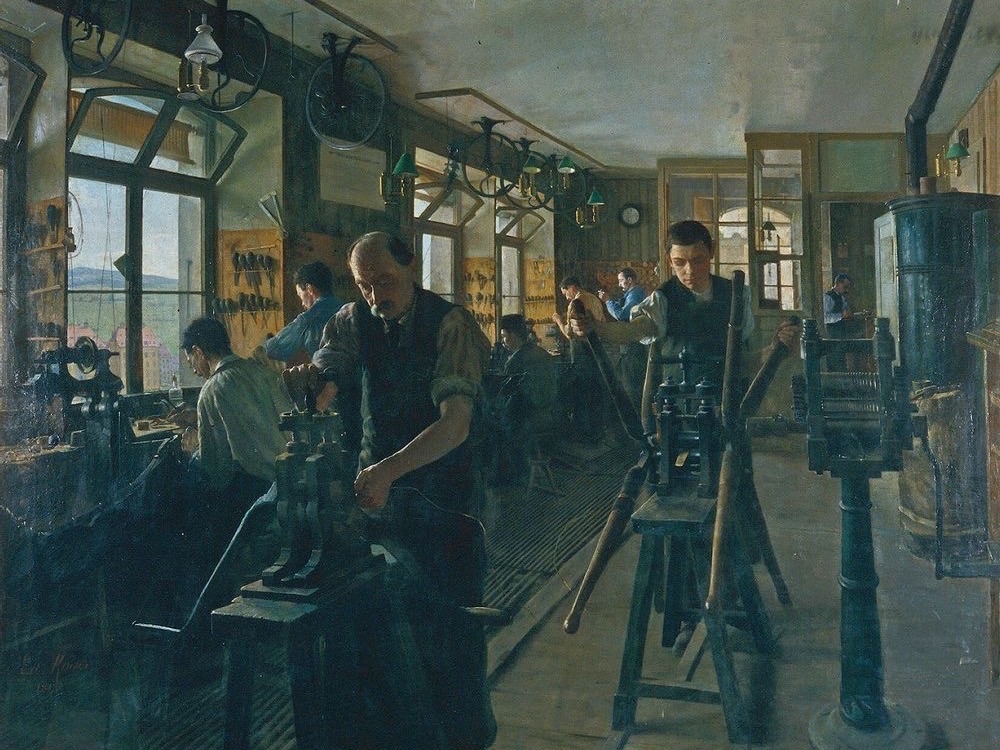
Watches in parts
Établissage was the Swiss way of making watches by outwork: the watch was made in "parties brisées", separate parts produced by different home workers, then gathered, assembled and adjusted by an établisseur in his comptoir and sold abroad by merchants.1, 2
The Historical Dictionary of Switzerland counts it as a putting-out system (Verlagssystem) and as protoindustry: long growth without factories, built on home work, before the turning point of the 1870s and 1880s.1
French Wikipedia cites Georg-Albert Berner's professional dictionary, which describes établissage as assembling a watch from bought-in ébauches, regulating parts and other supplies: receiving and checking them, assembling, regulating, fitting dial and hands, casing and final checks.2
In the mountains and in Geneva
In La Chaux-de-Fonds the industry took this form from the early 18th century. The historian Pierre-Yves Donzé, quoted on Wikipedia, finds no real industrial firm there before the 1880s.2, 4
French Wikipedia notes that établisseurs were not all equal: some sold directly to markets, others worked to order for bigger merchants, and their suppliers were themselves organised in layers of subcontracting.2
In the Vallée de Joux the établisseur was a finisher (repasseur) who ordered and collected components from neighbours and kin and assembled complicated movements, like a conductor; Audemars Piguet says almost all of Louis Audemars & Fils' workers in 1833 worked at home.5, 6
Home work made watchmaking a winter trade for farming families, and so Jura farmhouses and later town houses were built with long rows of windows for light at the workbench.6, 7
Geneva worked differently. Its cabinotiers worked in small, independent workshops (cabinets), mostly in the Saint-Gervais district, and were engravers, jewellers and gem-cutters as well as watchmakers.1, 2, 8
The trades multiplied: the Historical Dictionary of Switzerland counts more than thirty in Geneva's Fabrique by a census of 1788, and fifty-four watch trades in La Chaux-de-Fonds by 1867.1
Machines and after
Mechanisation began inside the system: Frédéric Japy at Beaucourt in the French Jura made ébauches by machine from 1776, so that the rough movement became a bought-in standard part.1, 9
The towns were shaped by it. UNESCO says the layout of La Chaux-de-Fonds and Le Locle mixed housing and workshops to suit the cottage industry and later adapted to factory production.7
Factories did not end it. In the 20th century the industry still had three forms of production, manufacture, établissage and terminage (assembly to order), and the Historical Dictionary of Switzerland says most Swiss brands in the early 21st century are again établisseurs that buy movements and parts.1
Key dates
- 1776
Japy makes ébauches by machine at Beaucourt.9
Where Établissage leads
- Part of, HistorySwitzerland’s network of specialists
How parts made in homes were gathered, assembled and sold as watches.1, 2
- See also, PersonGeorges Favre-Jacot
French Wikipedia says he broke with établissage and made everything under one roof.10, 11
- See also, PlaceLa Chaux-de-Fonds and Le Locle
ICOMOS describes rural specialists making single parts for an établisseur, the system the towns were built around.4, 12
- See also, PlaceThe Jura Arc
In La Chaux-de-Fonds the industry took this form from the early 18th century.2, 4
- See also, EventThe Philadelphia Centennial Exhibition
David argues for American methods without bringing every trade under one roof, keeping separate suppliers working to common standards.13
- See also, EventThe Swiss watch cartel and statute
The Federal Council wrote that the manufacturing permit let it control the opening of new assembling firms working by établissage, and the établisseurs objected strongly to it.14
Facts and sources
- Period
- From the 17th century to the factories of the late 19th century, and in new forms after1, 2
- Where
- The Swiss Jura (Neuchâtel mountains, Vallée de Joux) and the French Jura around Morez2, 4, 5
Sources
- 1
- 2
- 3
- 4
- 5
- 6
- 7
La Chaux-de-Fonds / Le Locle, Watchmaking Town Planning (opens in a new tab)
- 8
- 9
Watchmakers' and Inventors' Hall of Fame: Frédéric Japy (opens in a new tab)
- 10
- 11
Georges Favre-Jacot - Visionary Watchmaker (opens in a new tab)
- 12
La Chaux-de-Fonds / Le Locle (Switzerland), No 1302: ICOMOS evaluation (opens in a new tab)
- 13
- 14
Sources read November 12, 2026.